
Scraping Multiple Sites Into One Normalized Schema
Five source sites, five different markup shapes, one Qasida table. sources.py and a parser_type string are what keep the crawler from turning into five unrelated codebases.
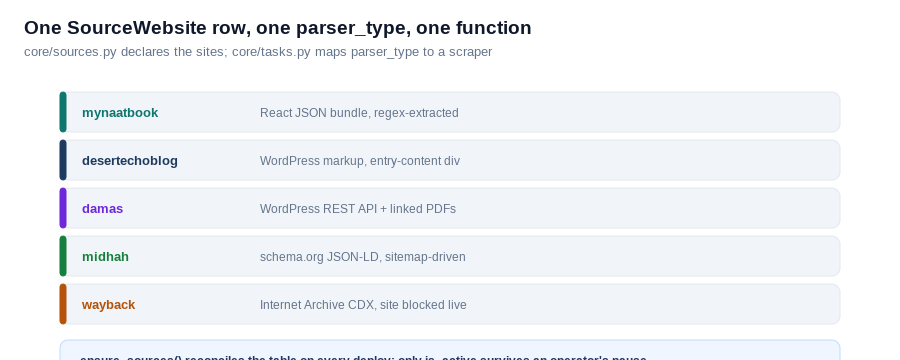
Five sites, one schema. The interesting design decision isn't the scraping code for any single site — it's the seam between "site-specific extraction logic" and "one Qasida record," and how thin that seam is kept.

ensure_sources() reconciles the table on every deploy; only is_active survives an operator's pause.
Sources live in code, not only in the database
core/sources.py declares the default crawl targets as a plain Python list:
DEFAULT_SOURCES = [
    {
        'url': 'https://www.mynaatbook.com/',
        'name': 'My Naat Book',
        'parser_type': 'mynaatbook',
        'is_active': True,
    },
    ...
    {
        'url': 'https://www.qasidacollection.com',
        'name': 'Qasida Collection (archive)',
        'parser_type': 'wayback',
        'is_active': True,
    },
]
ensure_sources() runs from the entrypoint on every deploy and reconciles the SourceWebsite table against this list — but only refreshes descriptive fields, deliberately leaving is_active alone:
def ensure_sources(model):
    for spec in DEFAULT_SOURCES:
        obj, was_created = model.objects.get_or_create(url=spec['url'], defaults={...})
        if was_created:
            created.append(spec['name'])
            continue
        changes = {}
        if obj.name != spec['name']:
            changes['name'] = spec['name']
        ...
Keeping the canonical list in code means a fresh deployment starts with the full set of sources instead of an empty table — but an operator's decision to pause a misbehaving site in the admin survives every restart, because that field is explicitly excluded from the reconciliation.
parser_type is the whole indirection
Each SourceWebsite row carries a parser_type string, and run_crawlers() dispatches on it against a flat dict:
scrapers = {
    'mynaatbook': scrape_mynaatbook,
    'desertechoblog': scrape_desertechoblog,
    'damas': scrape_damas,
    'midhah': scrape_midhah,
    'generic': scrape_generic,
    'wayback': scrape_wayback,
}
for website in active_websites:
    scraper = scrapers.get(website.parser_type)
    if scraper is None:
        print(f"Unknown parser type '{website.parser_type}' for {website.name}")
        continue
That's it — no plugin registry, no dynamic import, no abstract base class with five required methods. A new source with genuinely novel markup gets a new function and a new string; a source with no bespoke parser at all falls back to scrape_generic, which tries schema.org JSON-LD first and the densest text block second (core/extract.py).
The four scrapers are honest about disagreeing with each other
What normalizes the output isn't a shared base class — it's that every scraper ends at the same Qasida.objects.create(...) call with the same field names, however differently it got there. scrape_mynaatbook reads a React bundle with regex; scrape_damas walks a WordPress REST API, extracting a PDF's text layer when the post body is empty, falling back to OCR when the PDF's text layer turns out to be shattered; scrape_midhah reads schema.org MusicComposition JSON-LD off a Next.js site whose class names are build-hashed and therefore useless to scrape structurally.
Each scraper also degrades on its own terms. scrape_damas keeps a scan-only post rather than discarding it when no legible text exists — "the scans are the content: keep the post and show the images rather than dropping it" — and only deletes the row if every image candidate turns out unreadable. That per-source judgment call about what counts as "worth keeping" doesn't belong in a shared abstraction; it belongs in the function that actually understands that source's failure modes.
Politeness is the one thing genuinely shared
The one piece of infrastructure every scraper does share is fetching.py's polite_get() — one request at a time per host, a per-host minimum delay (1.5s default, 6s for qasidacollection.com, 4s for web.archive.org), exponential backoff on 429/500/502/503/504, and Retry-After honored when a server sends it. Rate-limiting logic is the part that's genuinely the same problem no matter which site you're hitting, and it's the one abstraction that earned being shared.
Series: Qasida App.