
A Version Tag With a Story: Why It's 1.0.1, Not 1.0.0
A single dropped connection during sign-in was enough to break Login Flow v2 in Photo Sweep 1.0.0. The fix is why the F-Droid submission and every release link point at v1.0.1 instead.
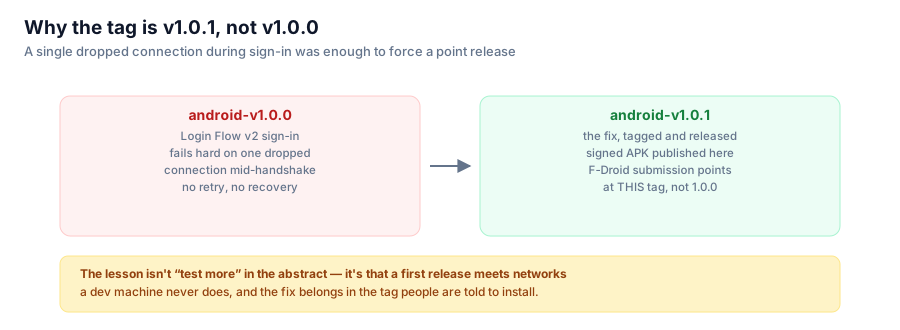
Every reference to Photo Sweep's Android release in the launch materials — the F-Droid submission, the GitHub Release link, the forum post — points at android-v1.0.1, not 1.0.0. That's not a stylistic preference for the newer tag. It's because 1.0.0 has a real bug, found quickly, and the point release exists specifically to fix it.

One dropped connection during sign-in, and the retry logic to survive it.
What broke
Sign-in uses Nextcloud's Login Flow v2: there's no login form in the app itself. The user is handed off to their own server's login page in a browser, so whatever two-factor or single sign-on that server enforces still applies, and what comes back to the app is a revocable per-device app password rather than the real account credential.
In 1.0.0, that handoff had no tolerance for a single dropped connection during the exchange. If the network blipped at exactly the wrong moment mid-handshake, the flow failed outright — no retry, no recovery path, just a failed sign-in that had to be started over from scratch. That's a rough failure mode for the very first interaction a new user has with the app: a bad network moment on first launch, and the demo is already off to a bad start.
Why a point release, not a patch note
The fix was straightforward, and it went out as android-v1.0.1 rather than being folded silently into a re-tagged 1.0.0, for a reason that matters for anyone downstream: F-Droid and any other distribution channel needs to point at a specific, immutable tag. Rewriting what 1.0.0 meant after the fact would corrupt that reference for anyone who'd already fetched the original tag. A new tag is the only honest way to say "this is different code" once a tag has been published at all.
That's also why the F-Droid submission explicitly calls out which tag to build against: submit against android-v1.0.1, not 1.0.0 — 1.0.0 has the sign-in bug that fails on a single dropped connection. Leaving that instruction implicit would have meant a real chance that the version F-Droid builds and signs is the version with the known bug in it, purely because 1.0.0 sorts earlier and might otherwise be an unremarkable default.
What it says about first releases generally
The interesting lesson here isn't "test networking more thoroughly," stated in the abstract — that's true of every release and doesn't explain much. The sharper version is that a first release meets real network conditions a development machine mostly doesn't: flaky mobile connections, Wi-Fi handoffs mid-request, VPNs that drop mid-handshake. Login Flow v2's browser-handoff design is good specifically because it defers authentication complexity to the server's own login page — but the handoff itself, the part actually implemented in the client, still has to survive a connection dying at the wrong instant, and that's exactly the kind of edge case that a manual test pass on a stable connection won't surface.
The fix, once found, was small. Finding it required exactly the kind of condition — real users, real networks — that a launch is what actually generates.
The practical takeaway
If a first Android release is going out through F-Droid, GitHub Releases, or any channel that gets pointed at by name, be ready to cut a 1.0.1 quickly if something real turns up in the first days, and be explicit — in submission paperwork, in release notes, wherever people are told what to install — about which tag is the one to actually use.
Series: Launching Photo Sweep.