
A Snapshot of the Tech Debt I'm Carrying, and Why Each Piece Is Stuck
AGP9/Gradle9 blocked, npm frozen by an upstream Nextcloud webpack pin, Kotlin held at 2.4.10 for CodeQL's sake. Four items, four different reasons none of them can move yet.
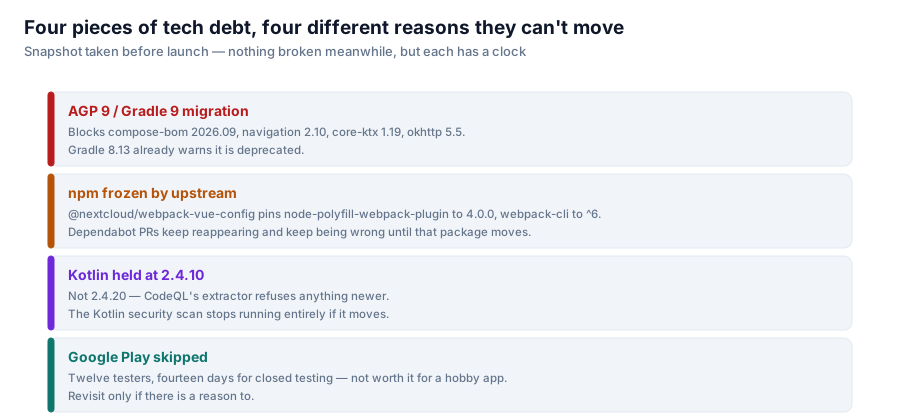
Right before launch is the honest moment to write down what's stuck, because it's the last point where the list is short enough to actually read. Photo Sweep's loose-ends snapshot has four items on it, and the useful thing about writing them up together isn't the list itself — it's that each one is stuck for a completely different reason, which means each one needs a different kind of attention, or none at all for now.

Nothing here is broken today. Each item just has its own clock.
AGP 9 / Gradle 9 — the one real piece of outstanding work
This is the closest thing on the list to a normal to-do item: an Android Gradle Plugin and Gradle major-version migration that hasn't happened yet. It's not optional forever — Gradle 8.13 already warns that it's deprecated, so there's a clock on it whether or not I look at it.
What makes it worth naming specifically is what it's blocking: compose-bom 2026.09, navigation 2.10, core-ktx 1.19, and okhttp 5.5 all require the migration and are frozen until it happens. Nothing is broken in the meantime — the app builds and ships fine on the current toolchain — but four dependency updates are queued up behind one piece of work, which is exactly the kind of debt that compounds quietly if it's left long enough.
npm — frozen by someone else's decision, not mine
The Android client isn't the only thing in this codebase; there's an npm side tied to Nextcloud's own front-end tooling. That side is frozen, but not by anything I control: @nextcloud/webpack-vue-config pins node-polyfill-webpack-plugin to exactly 4.0.0 and webpack-cli to ^6.
The practical consequence is Dependabot noise: PRs proposing to bump those packages will keep reappearing, and they'll keep being wrong, until upstream moves the pin. There's no fix on my side — closing each PR as it arrives is the whole workflow until Nextcloud's own webpack config changes.
Kotlin held at 2.4.10 — a scanner's fault, not a language one
Kotlin 2.4.20 is out and would otherwise be an easy bump. It's held back at 2.4.10 specifically because CodeQL's extractor refuses to process anything newer, and moving forward means the Kotlin security scan stops running entirely rather than degrading gracefully. That's a worse trade than staying one point release behind: a silently disabled scanner is a bigger risk than a slightly stale compiler.
This is the item on the list I'm least able to unblock myself — it depends on CodeQL fixing their extractor, not on anything in this repository.
Google Play — the one item that's stuck by choice, not by blocker
This one's different in kind from the other three: it isn't blocked, it's declined. Google Play's closed-testing requirement — twelve testers, fourteen days, before any app can reach a public listing — is a real structural cost for a hobby project maintained by one person in spare time. Revisiting it isn't waiting on an external fix; it's waiting on a reason to bother. (There's a fuller version of that reasoning in its own post.)
Why the snapshot is worth publishing at all
None of these four items reads as impressive, and that's rather the point of publishing the list. A tech-debt snapshot that only lists things you're proud of fixing isn't honest bookkeeping — it's a highlight reel. The useful version says plainly which things are frozen by someone else's schedule, which are frozen by your own choice, and which are just waiting for you to find the time. Distinguishing those three categories is most of what "managing" tech debt actually consists of.
Series: Launching Photo Sweep.